
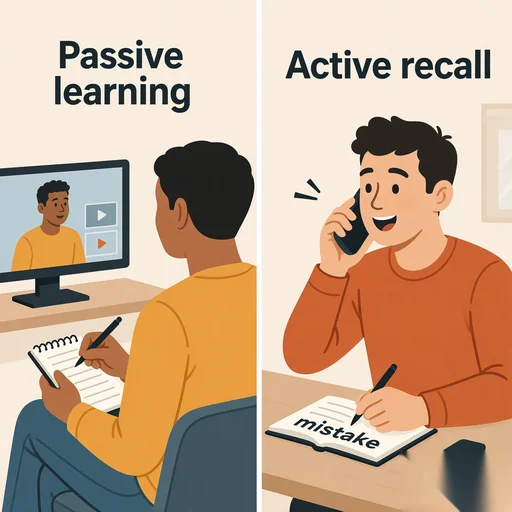
If you’ve been trying to learn English by yourself and feel stuck, the missing piece isn’t more apps or grammar books—it’s a structured, self-directed method that combines daily micro-practice, active recall, and real-world output. Most self-learners jump between random YouTube lessons and vocabulary lists, which creates the illusion of progress without tangible results. The solution is a three-phase system: diagnose your current level precisely, build a 20-minute daily routine that targets your weakest skill, and then force yourself to produce English (speaking or writing) every single day. No magic, no expensive courses—just a repeatable process.
Let’s start with the real problem. When you learn alone, there’s no teacher to point out what you’re mispronouncing or which grammar mistake you repeat every five sentences. So you keep studying the same topics—present perfect, conditionals, business email phrases—but in conversation, you still freeze. That happens because your brain separates “studying” from “using.” You’ve trained recognition (understanding a word when you see it) but not recall (pulling that word naturally in a sentence). The principle here is called “desirable difficulty”: learning sticks only when you struggle to retrieve information. Passive listening or re-reading notes feels easy, so it fails.
To fix this, you need a weekly loop: test, isolate, practice, output. First, take a free level test (like the EF SET or Cambridge’s quick placement test). Be honest about your weak areas—maybe it’s listening to fast native speech or using prepositions correctly. Then isolate one sub-skill for five days. For example, if listening is your weakness, don’t just watch Netflix with subtitles. Instead, use the “shadowing” technique: take a 30-second audio clip from a podcast (choose something like “6 Minute English” from BBC), listen once, then speak along with the recording, mimicking the rhythm and stress. Do this for five minutes daily. Research shows that shadowing improves both listening accuracy and pronunciation faster than passive listening.
Here’s your step-by-step daily routine, designed for busy people. Step one (2 minutes): review a mistake journal. Every time you make an error in writing or speaking, write the incorrect sentence and the corrected version in a notebook. Read these two lines aloud each morning. Step two (10 minutes): focused input. Pick one grammar rule (e.g., “prepositions of time: in, on, at”) or five new words from a topic you care about (cooking, coding, cycling). Don’t memorize definitions. Instead, write three original sentences using each word or rule. Step three (8 minutes): output under pressure. Set a timer and record a voice memo answering a simple question like “What did you do yesterday?” or “How would you explain your job to a child?” Listen back and circle two things you said wrong—even if you have to guess. That’s your next day’s mistake journal entry.
Let me give you a case example. Marco, a 34-year-old engineer from Brazil, had studied English for seven years but still panicked during meetings. He could read technical documents but froze when asked an unexpected question. He started the routine above, but he added one twist: every Monday, he wrote a 50-word summary of a work email and then read it aloud to his dog (silly, but it removed the fear of judgment). After three weeks, he joined a free online speaking group (r/language_exchange on Reddit). He used the same 20-minute routine but replaced step three with speaking to a partner for 8 minutes. Within eight weeks, he stopped
You might be thinking, “That sounds good, but I don’t have a speaking partner.” Then use the mirror technique: every evening, answer three questions out loud for two minutes: What frustrated me today? What did I learn? What will I do differently tomorrow? Record it. You’ll hear your own errors—dropped -ed endings, wrong word order. That’s gold. Don’t try to fix everything at once. Pick one repeated mistake per week. Week one: all past tense verbs must end with a clear -t or -d sound. Week two: subject-verb agreement for he/she/it. Small wins build momentum.
Another practical tool: the 5-3-1 reading method. Take one article from a site like VOA Learning English (about 300 words). Read it once for meaning (5 minutes). Then read it again, but this time, highlight three sentences with unfamiliar structures (3 minutes). Finally, close the article and rewrite those three sentences in your own words from memory (1 minute). This forces your brain to reconstruct grammar patterns, which is ten times more effective than underlining. Do this three times a week, and within a month, you’ll notice that certain sentence patterns just “feel right” without you knowing the rule.
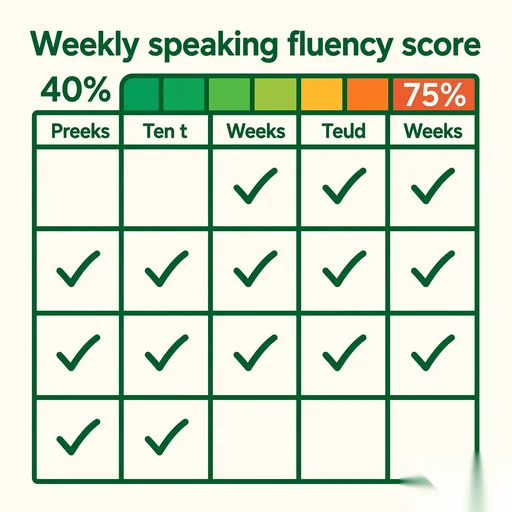
What about motivation? Self-learning fails not because the method is bad but because you stop. So build a commitment device: tell a friend you’ll send them a voice note every day at 8 PM. No excuses. Or use an app like “Beeminder” where you pledge $5 per missed day. Pain works. Also, measure progress with a concrete metric—not “I feel better” but “I can shadow a 60-second audio without stopping” or “I wrote 10 sentences with zero preposition errors.” Track that number daily. After 30 days, you’ll see a line going up. That visual proof replaces motivation with discipline.
One final warning: avoid the “app trap.” Duolingo, Memrise, and similar tools are excellent for vocabulary exposure but terrible for building spontaneous output. Why? Because they give you multiple choices and hints. Real conversation gives you no hints. So limit gamified apps to 5 minutes per day as a warm-up, not the main meal. The main meal is always production—speaking or writing without support. If you have no one to correct your writing, use LangCorrect or Journaly. Native speakers will correct your entries for free. Return the favor by correcting their attempt at your native language.
To wrap up: test yourself honestly, isolate one micro-skill, practice with forced output daily, and track one mistake at a time. You don’t need a teacher or a course. You need a system that replaces passive studying with active struggle. Start tomorrow morning with a 30-second voice memo. That single action—imperfect, short, real—will do more than any textbook chapter.
(Finally a guide that doesn’t tell me to “just watch movies.” The mistake journal idea is genius — I caught myself saying “I didn’t went” three times in one week. Fixed it in 5 days.)
(I’m a self-learner from Japan. The 5-3-1 reading method opened my eyes. I always just read and moved on. Now I actually remember sentence patterns. Thank you.)
(Honest question: How do I know if my pronunciation is wrong when I shadow? I record myself but I can’t hear the errors because my ear isn’t trained.)
(As an ESL teacher, I’ve recommended this approach to dozens of students. The emphasis on output over input is the single biggest shift most learners need. Great breakdown.)
(Been using the voice memo method for 2 weeks. Yesterday I answered a surprise question at work without pausing to translate. Almost cried. It works.)
Summary: Stop passive learning. Use daily output, mistake tracking, and shadowing to build real fluency alone.
ActiveRecallFINISHED英语自学指南生成




speaking or writing
understanding a word when you see it
like the EF SET or Cambridge’s quick placement test
pulling that word naturally in a sentence
choose something like “6 Minute English” from BBC